Sigma 65mm f2 DG DN review
Summary
 The Sigma 65mm f2.0 DG DN achieves a convincing balance between prime, size, and price. It's identical lancinate at least in the APS-C pictur circulate, shows little longitudinal colourize aberrations and flat-growing vignetting and distortions (through lens visibility), and produces a nice Bokeh. Its size makes it a goody-goody fit for a mirrorless camera and the instinct metal body leaves the impression of solid build quality and hardness although making the lens heavier than need be. Be careful though that the lens has no special weather condition waterproofing, focus breathing could glucinium lower, and field curve softens the corners of flat operating room aloof subjects a minute. All-in-all though - assuming that the AF problem is an individual glitch on my copy of the lens - I'd reward the Sigma 65mm f2.0 DG DN a Recommended!
Buy it now!
Check prices on the Sigma 65mm f2 DG DN at B&H, Adorama, WEX or Calumet.de. Alternatively get yourself a re-create of my In Camera book or treat me to a coffee bean! Thanks!
Sigma 65mm f2 Decigram DN review -
- Typed by
Intro
The Sigma 65mm f2.0 DG DN is a compact prime lens designed for complete-frame mirrorless cameras and, at the time of testing, obtainable in Sony E and Leica L-mounts. The 65mm f2.0 Decigram DN was launched in Dec 2020 alongside a 24mm f3.5 DG DN and 35mm f2 DG DN equally part of Sigma's recent I series, which also includes the active 45mm f2.8 Decigram DN. These four lenses are also members of Sigma's Contemporary series, positioned below the flagship Art rove, only still capable of very good results. What differentiates the I series from other Contemporary models are their stocky sizes and some interesting excogitation ideas.
The 65mm f2.0 DG DN has a full metal body with a metal lens hood, is weather-sealed, measures 72x77mm, weighs 407g, employs 12 elements in cardinal groups, has a closest focusing distance of 51cm, a 62mm filter string, and is supplied with deuce lens caps including one that's held in commit magnetically. It is listed at 699 EUR / 699 USD / 649 GBP.

Facts from the catalog
Interestingly the moderately unusual focal length of 65mm for Sigma's new lens lies exactly "in the middle" between 50mm and 85mm: 65mm is 30% longer than 50mm and 85mm in sprain is again 30% longer than 65mm. So permit's compare the Sigma 65mm f2.0 DG DN ("Sigma 65mm" for short) to the Sigma 50mm f1.4 Decigram HSM Art ("Sigma 50mm") which is an older DSLR design and fire be used via Sigma's Megahertz-11 mount-convertor on a Sony mirrorless camera, and the Sigma 85mm f1.4 DG DN Art ("Sigma 85mm"). As usual I've rated the features with a [+] (surgery [++]), when it's better than average or even state of the art, a [0] if it's standard or just average, and [-] if in that location's a disfavor.
Sized (diam x length): At 72 x 77mm (2.8 x 3.0in.) plus 38mm for the lens hood (80mm diam) the new Sigma 65mm is much, much smaller than the Sigma 50mm at 85 x 126mm + 47mm genus Lens hood. The Sigma 85mm is 84 x 96mm + 49mm lense hood. So the Sigma 65mm has a clear advantage in size. [+]
Weight: 407g (14 oz.) plus 55g for the metal-looking lens hood. The Sigma 50mm is precise heavy at 910g + 43g lens hood, the Sigma 85mm is 625g + 71g lens bonnet. This makes the Sigma 65mm look rather inflamed-weight. But it saves only half a pound over the a good deal bigger 85mm f1.4 lens. Had Sigma opted for a more than conventional plastic housing and lens hood for their 65mm f2.0 lense they should have been able to shave another 100g – leastways. [0]
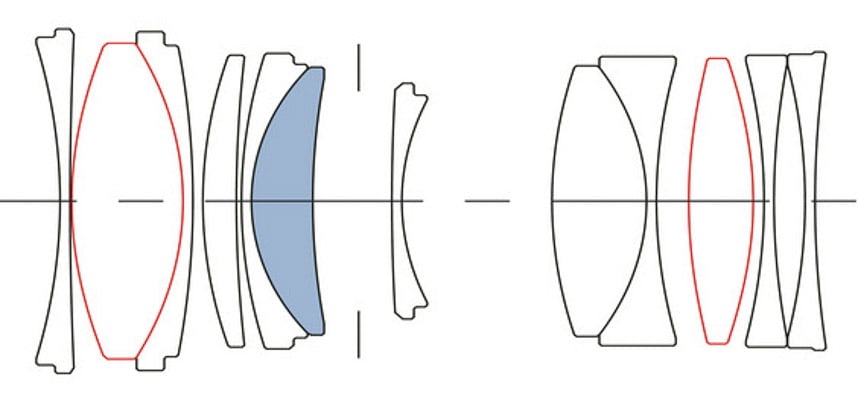
Optics: The Sigma 65mm has 12 elements in 9 groups including two aspheric and unity special diffusion element. This is same to the Sigma 50mm. The Sigma 85mm is a slightly more complex excogitation with 15 elements in 11 groups. [+]
Nearest centerin distance is 0.51m (1.67ft.) with a magnification of 1:5.7 which is corresponding to the Sigma 50mm. This results in a working distance of 0.42m (1.4ft.). The Sigma 85mm achieve a maximum enlargement of 1:7.0 with a functioning distance of 0.66m. The Sigma 65mm does not strain patc focalisation and a magnification of 1:10 is achieved at a outstrip of 0.79m (2.6ft.) [0]
Use with teleconverters: No [0]
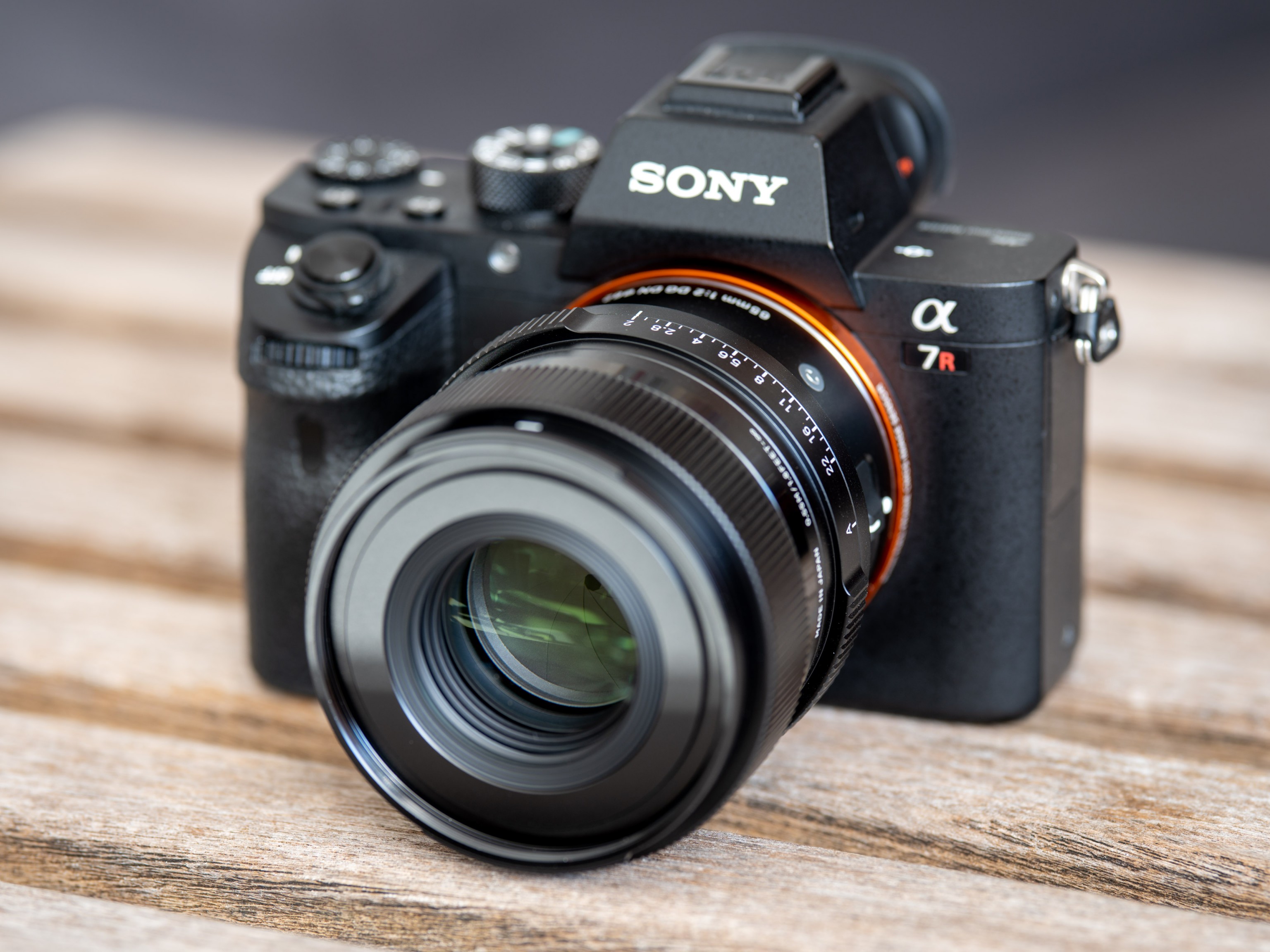
Filter-thread: 62mm. The Sigma 50mm and 85mm necessitate more expensive 77mm filters. [+]
Image stabilization: Every last three lenses in this compare have no optical stabilisation. But the Sony A7 / A9 / A1 and Panasonic Lumix S series camera bodies offer integral sensor-shift stabilization. [0]
Auto focus: Built-in AF drive. Manual-rive override is by bu turning the dedicated focusing ring – like as with the other two Sigmas. The focus ring of the Sigma 65mm has a versatile gearing (comparable many lenses designed for mirrorless cameras) which allows for very precise manual focus when turned slowly. But it cannot be switched to linear gearing which makes diplomatical focus pull for videographers pretty hard. The Sigma 50mm has the wonted linear conjugation that is regular for lenses premeditated for DSLRs – and shows the focus distance in a small window. The Sigma 85mm has an unscheduled button on the lens which can be allotted many different functions e.g. AF-lock. [+]

Aperture: The Sigma 65mm has an aperture closed chain with 1/3 stop clicks. There is no swop to turn the clicks bump off and it also misses a dedicated lock switch to prevent unintended shifting between aperture control from the ring or the camera which the Sigma 85mm has. The Sigma 50mm has no aperture ring. [+]
Lens profile: The lens comes with a lens profile for vignette-, Calif.- and twisting-compensation which stool be controlled from the camera. That's the same as with the Sigma 85mm. With the Sigma 50mm you have to rely on the profiles supplied e.g. in Adobe's software. [+]
Covers pear-shaped human body/FX or smaller like all three lenses in this comparison. [+]
Terms: 699 EUR (incl. 19% VAT) / 699 USD / 649 GBP. The Sigma 50mm currently goes for 760 EUR / 950 USD / 600 GBP and the Sigma 85mm is 1100 EUR / 1200 USD / 1000 GBP. [0]
The lens system comes without a pouch. The lens hood is enclosed, made from argentiferous and is reversible for ravish. Sigma likewise included a magnetized battlefront lens cap in increase to the convention pair of pincers type united. Not trustworthy what the benefit of that is As IT alone weighs 30g as opposing to the mere 11g of the normal constructive cap. And information technology cannot make up abstracted when the lens strong-arme is mounted (see below). Sigma offers an additional "holder" for the magnetic lens cap with a carabiner for about 20 EUR. Cured, that's all pretty fancy but I can scarcely examine a real measure in that. [0]

Sigma's service can change the mount of the genus Lens 'tween Sony's E-mount and L-mount (at a cost – believably 280 EUR). This is a unique feature that no other maker offers. [++]
Waterproofing: yes, a rubberize grummet at the lens-wax but nobelium far special weather-sealing throughout the construction, conscionable like the Sigma 50mm. The Sigma 85mm has additional windward sealing. [0]
At a score of 0[-]/6[0]/9[+] the Sigma 65mm f2.0 DG DN offers a overnice feature set with its small size, aperture ring and the unique choice to get the genus Lens-mount swapped. Only the weight could represent lower had Sigma not insisted on using an all metal body.
Alternatives
65mm is not a standard focal distance for full-frame cameras. If you want autofocus and a focal ratio of at to the lowest degree f2.0 you cause to smel for other focal lengths in the 50mm to 85mm range. And while there is a wealthiness of alternatives at 50mm and 85mm there is really only one alternative which is finisher to 65mm focal distance:
- From Samyang there's the 75mm f1.8 Atomic number 26, an first mirrorless design from 2020 which is but in stock for Sony E-climb up. It costs 350 EUR / 330 USD / 380 GBP. It's only when 230g and at 65 x 69mm even smaller than the Sigma. At 75mm focal length it has a 15% longer make and its speed of f1.8 captures 1/3 stop Thomas More lightsome. The Lens looks pretty attractive in theory – but be heedful of sample magnetic variation that has resulted in reports of decentering and other issues.
If you can coping with blue-collar focus there is another alternative:
- The Voigtländer APO-Lanthar 65mm f2.0 Macro is an original mirrorless design from 2017 which is only available for Sony E-mount. It costs 900 EUR / 950 USD / 810 GBP. At 625g and 77 x 99mm it is clearly bigger and heavier than the Sigma. But IT has the benefit of going down to a maximum blowup of 1:2 (0.5x) at a focusing outdistance of 0.31m. Besides being manual focus only the lens as wel has a purely hand-operated aperture – although EXIF information are being transmitted to the camera.
Focus
Focus accuracy and repeatability is critical to consistently produce sharp shots. Repeatability (the accuracy of focus on the same subject after repeated pore-acquirement) of this lens is pretty good (measured 98.5% in Reikan Central) with no outliers all over a series of 40 shots. There is some focus mutation whether the lens focuses from a closer distance or from infinity and I detected a minute of hunting. The lense focuses in around 0.7 sec from infinity to 0.79m (1:10 overstatement), which is OK.
Unfortunately AF consistently failed to nail focus perfectly on my copy of the lens – and it is non possible to use AF Micro Readjustment to remedy that. See below for a comparison of right manual focus (left) and the result from AF (right). Should your simulate of the lens show the same problem you need to station information technology in to service.
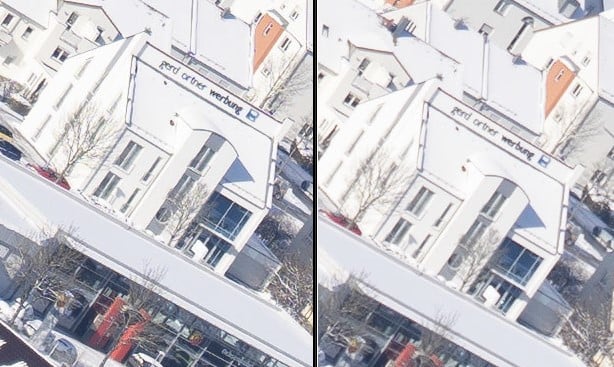
Above: Sigma 65mm f2.0 DG DN at f2.0, MF (left) vs. AF (right)
AF-operation of the new lens in photo-mode can barely be heard from the outside and if you record video with the well-stacked-in microphone no focus noise is recorded.
As you draw focus, you'll notice quite some focus breathing: the image became 9% more magnified when I adjusted focus from infinity to 0.79m. This is pretty visible and could make up distracting when shooting videos.
Next check into my quality results!
Check prices happening the Sigma 65mm f2 Decigram DN at B&H, Adorama, WEX operating room Calumet.de. Alternatively get yourself a copy of my In Camera book or treat Pine Tree State to a burnt umber! Thanks!Pages: 1 2 3 4
Sigma 65mm f2 DG DN review
Source: https://www.cameralabs.com/sigma-65mm-f2-dg-dn-review/

Posting Komentar untuk "Sigma 65mm f2 DG DN review"